One of Switzerland’s oldest watch names is back.
Founded in 1826 in La Chaux-de-Fonds, Gallet has relaunched 200 years after its founding.
Breitling acquired Gallet in 2025, and the revived brand officially unveiled its full 2026 collection on September 3. Gallet describes the comeback as a new era built around the idea of “wanderlust” — reconnecting the company with a history tied to aviation, motorsport, sailing and exploration.
But this is not a revival built around one commemorative watch.
Gallet has returned with four complete collections: the Flying Officer, Multichron Pilot, Multichron Sport and Gallet Classics.
And once dial colors, bracelets, straps and individual references are taken into account, the new lineup becomes far larger than those four collection names initially suggest.
Gallet’s current catalog allows many models to be configured across metal bracelets, leather, fabric and rubber, with numerous dial executions layered underneath the core product families.
That scale makes this one of the more ambitious heritage-watch relaunches in recent memory.
Where Gallet Comes From
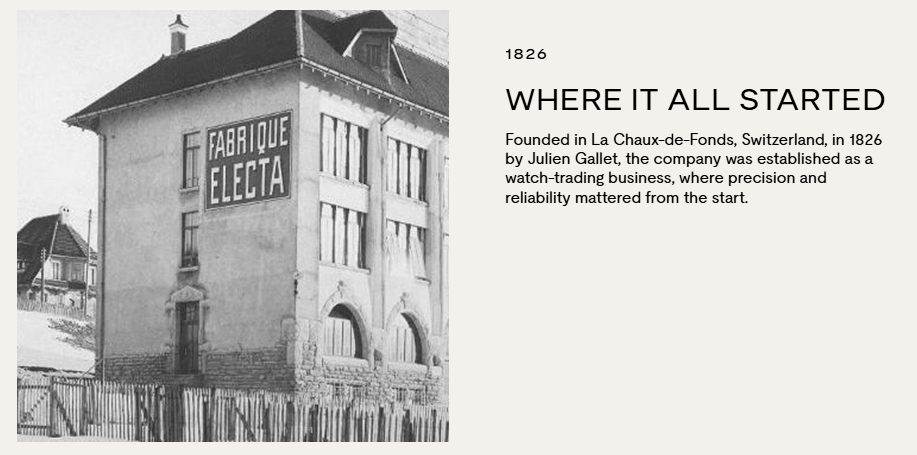
Gallet’s current historical timeline begins in 1826, when the company was founded in La Chaux-de-Fonds.
Over the following century, the brand became closely associated with timing instruments built for emerging forms of transportation and competition.
Gallet’s own historical archive highlights watches connected with aviation, motorsport, diving, sailing and exploration, including the Multichron family and Flying Officer.
The company’s modern revival leans heavily into that history, but it is not simply reproducing old watches one-for-one.
Instead, the 2026 collection takes historic names and design cues and adapts them around modern case sizes, contemporary movements, current travel use and a much broader range of configurations.
Flying Officer: A World-Traveler Since 1939
The Flying Officer is arguably the most historically recognizable name in the revived lineup.
Gallet says the model was first introduced in 1939, during the early era of intercontinental air travel.
Its purpose was unusually practical: pilots could use the watch’s rotating city ring to track the time at upcoming refueling stops around the world.
Former U.S. President Harry S. Truman was among the watch’s notable wearers.
For 2026, Gallet has retained the world-time concept but reworked the city ring around 24 contemporary destinations, reflecting modern travel rather than reproducing the geography of 1939.
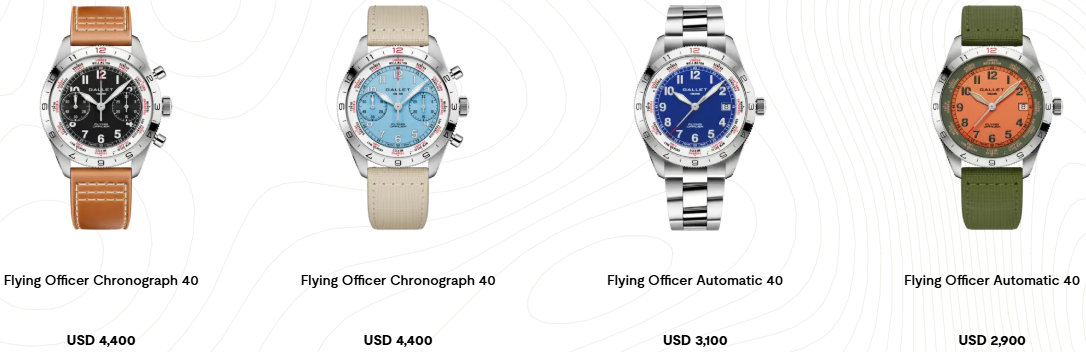
The modern Flying Officer comes in both automatic and chronograph form.
The 40mm Flying Officer Automatic uses the self-winding Gallet 17 calibre, offers approximately 38 hours of power reserve, 100 meters of water resistance and starts at $2,900 in the United States.
The 40mm chronograph version uses the automatic Gallet 23 calibre with approximately 65 hours of power reserve, 100 meters of water resistance and pricing beginning at $4,400, with bracelet-equipped versions reaching $4,600.
That $2,900 starting point is important.
It puts the revived Gallet in a price range that many serious enthusiasts can realistically consider, rather than positioning the brand solely as an ultra-high-end historical curiosity.
The Multichron Story Begins in 1938
The Multichron name predates the Flying Officer.
Gallet’s historical archive traces the collection to 1938, when the Multichron became part of a family of chronographs designed for precision timing across multiple disciplines.
One of the most significant early examples was the Multichron Clamshell, introduced in 1938.
Gallet describes it as one of the early waterproof chronographs, designed to resist dust, humidity and heavy rain in demanding environments.
The Multichron name later expanded into several specialized watches, including the Multichron Pilot.
Multichron Pilot: From 1969 to Modern Exploration
Gallet dates the original Multichron Pilot to 1969.
The historic watch was developed as a purpose-driven chronograph for long-duration timing and tracking a second time zone, with a rotating 12-hour bezel and scales intended to assist with measurements of speed and distance.
The 2026 interpretation measures 42mm and uses the automatic Gallet 23 chronograph calibre with approximately 65 hours of power reserve.
The watch includes a bidirectional bezel, date at 6 o’clock, telemeter scale and high-contrast dial layouts intended to maintain legibility in changing conditions.
Gallet currently offers black and blue dial families along with multiple strap and bracelet options.
U.S. pricing begins at approximately $4,400, with certain configurations listed at $4,600.

Multichron Sport: The Racing Side of Gallet
If the Pilot represents aviation and exploration, the Multichron Sport pushes the same historical family toward motorsport.
Gallet says the Multichron collection became closely connected with racing, where precise elapsed-time measurement was essential.
The new Multichron Sport is a 41mm stainless-steel chronograph built around a tachymeter scale and high-contrast dial design.
Like the Flying Officer Chronograph and Multichron Pilot, it uses the automatic Gallet 23 calibre, delivering approximately 65 hours of power reserve.
Water resistance is rated to 100 meters.
Prices currently begin at $4,400, with bracelet configurations reaching approximately $4,600.
Gallet positions the modern Sport less as a literal vintage racing-watch reproduction and more as an all-terrain chronograph — one that carries the historical racing language into a broader adventure-focused collection.

Gallet Classics: Where Breitling Becomes Most Visible
The fourth collection may be the clearest demonstration of how important Breitling is to the revival.
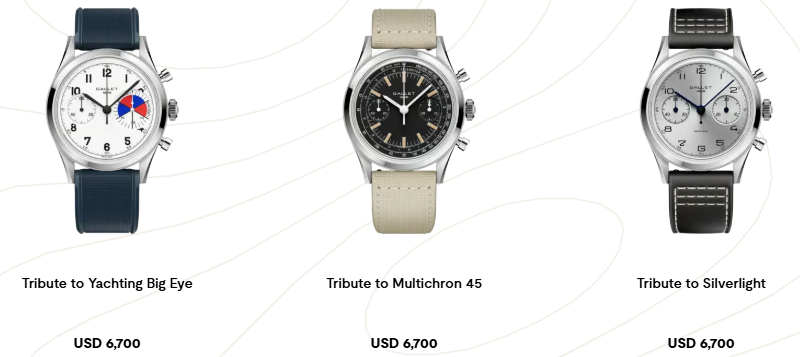
The Gallet Classics collection consists of three hand-wound chronographs inspired by archival pieces: the Tribute to Yachting Big Eye, Tribute to Multichron 45 and Tribute to Silverlight.
Each measures 38mm and is powered by the Breitling Manufacture Calibre B09, a hand-wound chronograph movement offering approximately 70 hours of power reserve.
All three are priced at $6,700 in the United States.
This is where the phrase “powered by Breitling” becomes literal.
While Gallet’s mainstream automatic chronographs use calibres carrying Gallet names, the Classics openly use a Breitling manufacture movement.
That gives the revival something many resurrected historical brands struggle to establish immediately: a credible modern movement and manufacturing foundation.
Four Collections — But Far More Than Four Watches
Spend a few minutes on Gallet’s website and one thing becomes obvious very quickly:
This is not a small launch.
The number of core families may be limited to four, but many references can be paired with metal bracelets, leather straps, fabric straps and rubber straps, often across multiple colors and dial treatments.
Some references are already available while others are listed for preorder.
That creates an unusually broad catalog for a brand effectively re-entering the modern market.
There is an advantage to that strategy.
Collectors can approach Gallet from very different directions: a relatively accessible automatic Flying Officer, a modern sports chronograph, an aviation-inspired Pilot or a smaller hand-wound heritage piece.
But there is also a risk.
A historical revival needs a clear identity.
Launching with a large configuration matrix gives buyers choice, but it also asks Gallet to establish several product personalities at the same time.
Whether that breadth becomes a strength or creates confusion will depend on how clearly the company develops each collection over the next several years.

What Breitling Is Actually Bringing to Gallet
The Breitling connection goes considerably deeper than ownership.
Gallet states that the revived watches are manufactured by Breitling and that the company now benefits from Breitling’s technical expertise, craftsmanship, global distribution network and after-sales service.
That matters because reviving a dormant or diminished watch name requires more than a logo and a historical archive.
A modern mechanical-watch company needs manufacturing capacity, quality control, movement sourcing, servicing, distribution, marketing and long-term product support.
Breitling already has that infrastructure.
The real test is whether that infrastructure can support Gallet without allowing the new brand to feel like simply another version of Breitling.
That distinction will be crucial.
Collectors interested in Gallet are likely to want the security and technical credibility that Breitling provides — while still expecting Gallet to develop its own recognizable identity.
The Price Strategy Is Aggressive
The pricing may be one of the most interesting parts of the relaunch.
The collection begins at $2,900 for the Flying Officer Automatic.
Automatic chronographs begin around $4,400.
And the hand-wound Breitling B09-powered Gallet Classics sit at $6,700.
That puts Gallet directly into some of the most competitive territory in Swiss watchmaking.
At those prices, the brand is not competing purely on nostalgia.
Buyers will compare these watches against established offerings from Tudor, Longines, TAG Heuer, Oris, Breitling itself and numerous independent manufacturers.
History may get Gallet attention.
The watches still have to earn the sale.